CMT
Cold Metal Transfer

CMT welding process:
the most advanced type of droplet detachment
High-speed, low-heat input, virtually spatter-free welding.
Wherever adhesive or solder was used before, CMT (Cold Metal Transfer) welding can be used instead. CMT has revolutionized welding technology and expanded the range of possible applications with its reversing wire movement.
The back and forth movement (reversing) of the welding wire - at up to 170 Hertz - produces an exceptionally stable arc. This results in a 33% reduction in heat input and a welding speed almost twice as fast as with conventional dip transfer arc.
The benefits of CMT


*Under laboratory conditions
**Compared with standard dip transfer arcSpecial features of CMT
During welding, the wire moves forward and is pulled back again as soon as the short circuit occurs. As a result, the arc only introduces any heat for a very brief period during the arc-burning phase. The result is spatter-free material transfer. The arc remains stable, regardless of the surface characteristics of the workpiece or how quickly the welding specialist works. This means that CMT can be used anywhere and in any position.


Welding does not inevitably have to mean welding spatter and rework. CMT promotes controlled droplet detachment during the short circuit, while the current is kept low. The result is virtually spatter-free material transfer.
*Compared with standard dip transfer arc

Heat input at the lowest level: as soon as the short circuit occurs, the wire is pulled back again during the CMT process. This means that the arc only introduces heat for a very short time.
As a result, CMT enables continuous regulation of the heat input from cold to hot. In addition, higher welding speeds and a wider range of applications* are possible with maximum weld quality.
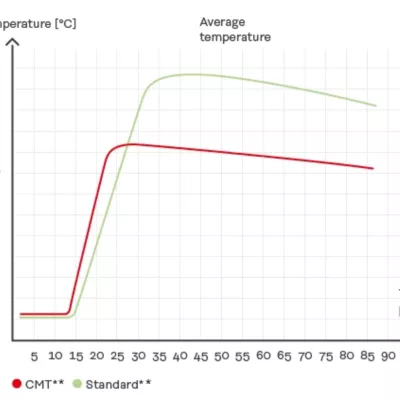
* Compared with standard dip transfer arc
**1.5 mm steel plate FW, PB 1.5 mm steel plate FW-TJ PB
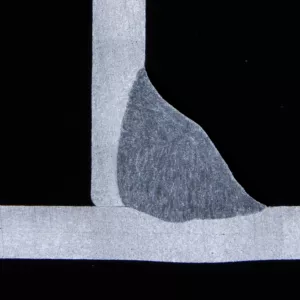
Result with standard dip transfer arc**
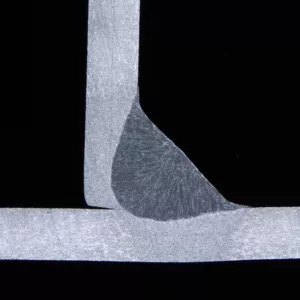
Result with CMT at 2x speed**
*Compared with standard dip transfer arc
**1.5 mm steel plate FW, PB 1.5 mm steel plate FW-TJ PB
Required hardware for CMT

- Joint welding (CrNi applications, food industry)
- Overlay welding
- Rapid prototyping and Fronius Additive
- Brazing, specifically with high demands for speed and process stability
- 100 % CO2 welding on steel
- Root passes
- Thin and medium sheet range
- Special joints, e.g., copper, steel aluminum, titanium
The CMT welding package – versatile applications: An overview of CMT processes
We offer optimal support for perfect seams in every application. For example, CMT Mix is ideal for aluminum applications - or for visible seams requiring excellent seam joining.


CMT AC - reverse polarity of the wire electrode
Remarkably low heat input with the same deposition rate by reversing the wire movement and the polarity of the wire electrode. You can easily adjust the positive and negative components with the help of correction parameters and thus achieve extremely precise control over the heat input.
CMT AC is available on the iWave AC/DC with Multiprocess Pro.


The Benefits of CMT AC
CMT cladding - 75 % less dilution of base and filler metals
In conventional overlay welding, the arc fuses a relatively large amount of the base material. The typical dilution and mixing of base material with filler material reduces the corrosion resistance of the applied layer. However, the base materials are melted to a lesser extent due to the lower heat input of the CMT process. This results in up to 75 % less metallurgical mixing of the base and filler materials, and reduces costs for overlay welding.


CMT Cycle Step
The welding specialist can therefore produce spots of any size and reproduce them precisely - a totally new level of control over the welding process.
Heat input is also minimal with Cycle Step, and can be effectively controlled. This allows even the thinnest of sheets to be joined and is particularly useful for position welding with gap tolerances. The defined welding cycles also ensure flawless seams in terms of appearance, with clear rippling and without excessive spatter, making Cycle Step ideal for high-quality visible seams.
The differences
- Stitch welding is a time-based process with a defined welding time and pause time.
- CMT Cycle Step is a process based on “droplet numbers” - the number of cycles defines the welding time, followed by the pause time. The interval cycles can also be defined.

Typical applications of CMT Cycle Step
Aluminum welding with CMT - an investment that pays for itself
Calculated per component, costs can be reduced by up to 43%*, so the higher investment costs involved with CMT are repaid in no time.
* In relation to the Standard Welding Package
Light gauge (≤ 1 mm) aluminum sheets can be welded. The low heat input of this process means that weld-pool support isn't necessary to keep the weld from dropping through.


Resource-conserving
This precisely controlled process reduces spatter, and therefore rework, which lets employees work more efficiently.
Material-saving
CMT significantly reduces the consumption of wear parts and the number of component rejects, which translates directly into greater savings potential.
